
Drive east out of Nice and you hit a decision about a mile in. Three roads, stacked one above the other, all going to roughly the same place. Most people take the middle one because the sat nav says so, and most people are wrong. That is the thing a French Riviera map fixes before you arrive: this coast is small enough to cross in a morning and complicated enough to waste a week on, and the difference comes down to knowing what sits next to what.
Map of the French Riviera Region: Coast, Corniches, and Distances
Nobody actually agrees on where the Riviera ends, which is worth knowing before someone tells you confidently. The core is the coastal Alpes-Maritimes, running from the Esterel massif east to Menton on the Italian border. Push the western edge out to Saint-Tropez and most people will nod along. Push it to Toulon and you are stretching. Monaco sits inside all of this as a semi-enclave, wrapped by France on three sides.
The name, oddly, is younger than the tourism. Stéphen Liégeard published La Côte d’Azur in December 1887, lifting it from his native Côte-d’Or and swapping the gold for the blue, and his own route opened at Hyères and closed at Menton. As definitions go, it has held up better than most of the ones that came after.
Which brings us back to those three roads, because the choice matters more than anything else on the map.

The Corniche Inférieure runs at sea level through Villefranche, Beaulieu and Cap d’Ail, beautiful and slow and thoroughly clogged from June onward.
The Moyenne Corniche threads the middle and delivers you to the gates of Èze, which is why the GPS loves it.
Highest of the three, the Grande Corniche climbs to around 500 meters, follows the old Roman Via Julia Augusta, was built under Napoleon I, and skips every town between Nice and La Turbie. Take that one. The view does something the other two cannot, and you will not spend an hour behind a coach.
Distances lie here, and they lie in one direction. Èze is 8.5 km (5.2 miles) from Nice and 4.5 km (2.7 miles) from Monaco, and neither will take the time you think, because the mountains push every road into switchbacks. Cannes is only 33 km (21 miles) from Nice, roughly half an hour when the road is clear and considerably more when it is not. Take the train and the question stops mattering. There is more on the boundaries in our guide to where the French Riviera is.

Best Cities and Towns to Visit on the French Riviera Map
Most people base themselves in Nice, and for a lot of them it is the wrong call. It is a real city with real traffic and Vieux Nice in August is a scrum. If a city is what you want, take it, but if the coast is the point, look at what sits either side of it.
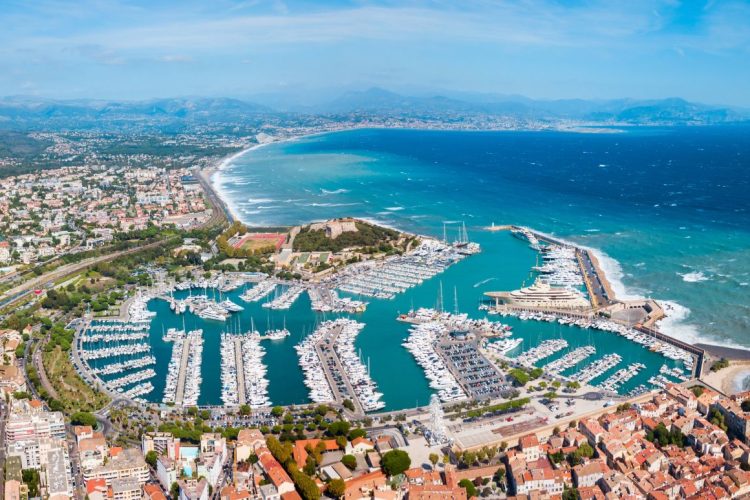
Antibes is the one we would argue for. The ramparts front the sea, the Marché Provençal is a working market rather than a photographed one, and the Picasso Museum occupies the Château Grimaldi, where Picasso worked. The curator handed him a room in mid-September 1946 and he stayed until mid-November, leaving 23 paintings and 44 drawings behind when he went back to Paris. The building took his name in December 1966. Two months of work, and it built a museum.
Just south of town you reach Cap d’Antibes, the most private stretch on this coast. The villas here sit behind pine and stone, invisible from the road, which is rather the point of them.
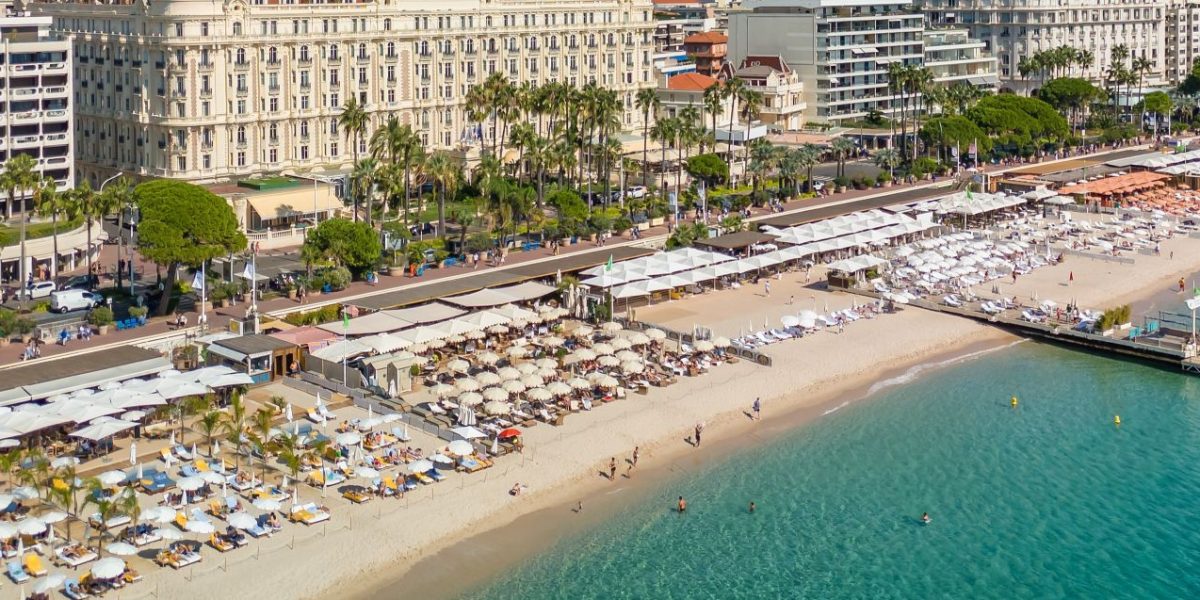
Cannes earns its reputation twice a year and coasts the rest of the time. Go in May for the Festival de Cannes, or go for the port and the islands, but do not expect the Croisette to move you.
Then there is Èze, clinging to a cliff around 427 meters (1,401 feet) up, which is how it earned the nickname eagle’s nest. It is a beautiful village that has been comprehensively discovered, so arrive before ten or do not bother at all.
We have a full guide to Èze, and a wider one on French Riviera cities and towns.

Coastal Attractions and Beaches Along the Côte d'Azur
The beaches change under your feet as you move west. Nice and Villefranche are pebbles, and anyone who calls that charming has not lain on them for an afternoon. Sand begins west of Antibes and runs on through Juan-les-Pins and along the Croisette.
If you plan around anything, plan around the Îles de Lérins. Ferries leave the Vieux-Port in Cannes and land at Sainte-Marguerite in fifteen to twenty minutes, and no cars are permitted on either island. The full loop of Sainte-Marguerite runs about nine kilometers on foot through forest, with coves you can swim off along the way. Saint-Honorat is quieter again, still owned by the Cistercian monastery that has held it since the 5th century. Twenty minutes from the Palais des Festivals, and it feels like a different century.
On water temperature, the numbers are less romantic than the brochures. Sea temperatures in August off Nice are around 24°C (75°F), March are roughly 13°C (55°F), and June is somewhere between 20°C (68°F) and 23°C (73°F). Our guide to the best beaches on the French Riviera gets into which coves repay the walk.
Planning Your Itinerary With a French Riviera Map
The instinct is to pick one central base and drive out from it every morning, and it is worth resisting, because summer traffic on the coastal roads will eat your holiday an hour at a time.
Cluster your days instead. Nice, Villefranche, Èze, and Monaco form one eastern arc, and you can do the whole thing without touching a motorway. Antibes, Cannes, and the Lérins islands form a western one. Saint-Tropez, whatever the map implies, is not a day trip, so either give it days of its own or leave it for another year.
More often than people expect, the coastal railway between Cannes and Menton beats the car, and it solves parking, which on this coast is not a small thing. As for when to come, September is usually the answer: the sea is still warm and the crowds have gone home. The trade-offs are laid out in our guide to the best time to visit the French Riviera.
Points of Interest to Mark on Your French Riviera Map
Of everything on this coast, the Villa Ephrussi de Rothschild is the one we send people to first. Béatrice de Rothschild built it on the isthmus of Cap Ferrat between 1907 and 1912 and then wrapped it in nine themed gardens. The main garden is shaped like a ship’s deck, meant to be seen from the loggia as though from a bridge, sea visible on either side, and she dressed her gardeners as sailors to complete the illusion. That is not restraint, and the place is better for it.
Monaco gives you the Prince’s Palace, the Oceanographic Museum, and the circuit that takes over the streets each May for the Monaco Grand Prix. Antibes fills its harbor with classic yachts for Les Voiles d’Antibes, and if you care about boats rather than noise, it is the better of the two.
Art runs through all of it. Matisse and Chagall both have museums in Nice, and the galleries of Antibes keep the line going.
Plan Your French Riviera Stay With Bucket List Villa
A map of this coast is not really about distance at all. It is about proximity, and about choosing a base you are not trying to escape every morning.
Which is the argument for a villa. Coffee on a terrace above the water, no lobby, no dining room hours, nobody else’s schedule but your own. Our team knows this coastline well enough to put you on the right side of it.
Speak to the Bucket List Villa reservation team and we will find the address that suits the trip you actually want.
Our team of experts is at your disposal to offer you a tailor-made service and meet all your requirements.
From finding the perfect villa to booking the trendiest restaurants and private excursions, we organize everything for you.